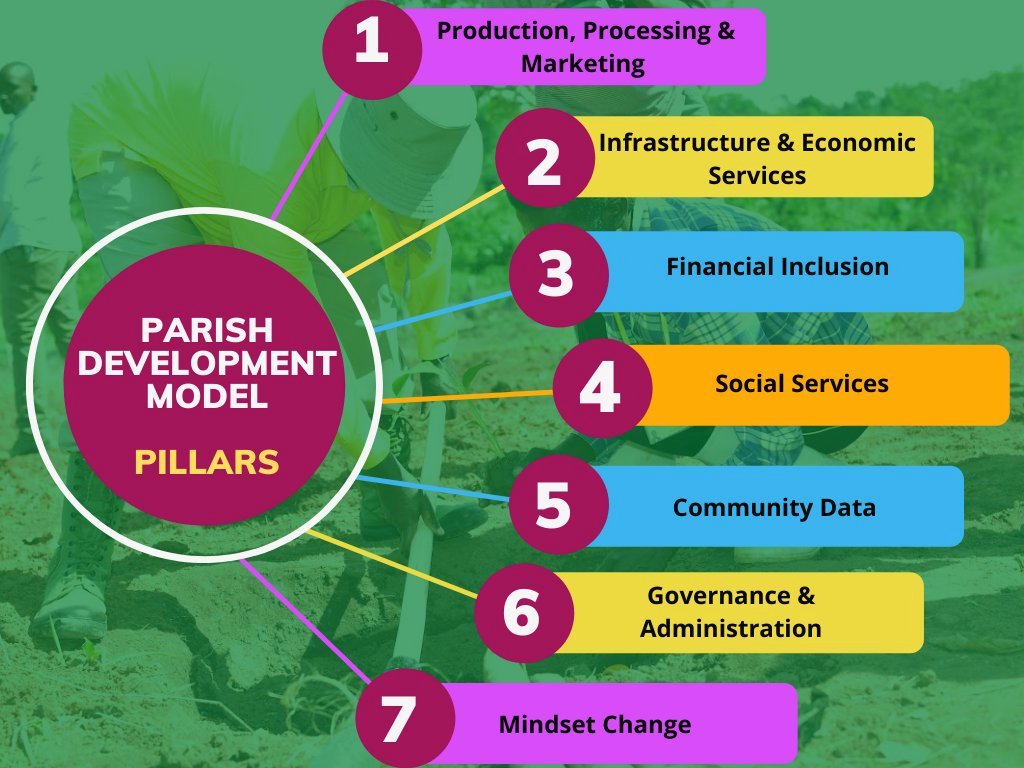
For five years now, the Parish Development Model has been the government’s biggest bet on “money to the grassroots.” The idea is simple: take capital away from Kampala offices and put it in 10,589 parishes, so a farmer in Bukomansimbi and a youth group in Lira can borrow to start something real.
The numbers are no longer small. Government says it has transferred close to Shs4.4 trillion as revolving capital to all parishes nationwide. By the end of this month, over 4 million beneficiaries are expected to have received funds. That makes PDM the largest direct household investment program Uganda has run in a generation.
For Ordinary Uganda: From Subsistence to “Something Small”
If you live in a village, PDM is supposed to mean this: You no longer wait for a politician’s envelope. You sit with your parish SACCO, apply as a household, and get money to buy goats, seeds, piglets, a grinding machine, or inputs for your acre.
In theory, it moves people from eating what they grow to earning from what they produce. For a woman group, it’s capital to start a bakery. For youth, it’s a boda or welding equipment. For a farmer, it’s irrigation pipes instead of praying for rain.
Reports from many parishes show movement. New pigsties, expanded gardens, and small shops that were not there two years ago. For households that were outside the money economy, that is real change.
But theory and ground truth are not always friends.
The Elite Uganda View: Scale, Systems, and Sustainability
For district planners, NGOs, and investors, PDM is a Shs4.4 trillion experiment in decentralized finance. It is tied to the Budget’s bigger goal: agro-industrialisation with Shs2.26 trillion allocated this FY, and a 10.2% growth target.
The strength is structure. Money goes to parishes, not individuals picked by name. SACCOs are supposed to manage it, with parish chiefs, CDOs and local leaders overseeing. That is deliberate, to reduce middlemen.
The risk is also structure. Shs100 million per parish sounds big until you divide it by hundreds of households. If selection is not transparent, the same “big names” eat first. If record keeping is weak, loans become grants. If markets are not ready, people produce more goats or maize with nowhere to sell.
Debt discipline matters too. PDM is “revolving” capital. If beneficiaries do not pay back, the next person gets nothing. If interest is too high or enforcement is harsh, people will run. If it’s too soft, the fund dies in one cycle.
Critical Analysis: What’s Working, What’s Leaking
Working:
Reach. Every parish has money. That is political and economic inclusion at scale.
Focus. Agriculture, value addition, and small enterprise are the right pillars for a country where most people are still in subsistence.
Momentum. 4 million beneficiaries is not a pilot. It’s a national wave.
Leaking:
Information gaps. In many parishes, people still don’t know the criteria, interest rate, or repayment period. Rumor replaces policy.
Capacity gaps. A parish SACCO run by volunteers cannot do banking for 300 households without training, audits, and digital tools.
Market gaps. Giving money for pigs is good. Ensuring there is a buying center and a fair price is better. Without markets, production becomes a loss.
Politics. Where local leaders turn PDM into patronage, the fund becomes a campaign tool, not a capital tool.
The Honest Question
PDM is not charity. It’s capital. Capital must return with interest, or it’s gone. So the question for every parish is not “who got money?” but “who paid back, who made profit, and who is ready for cycle two?”
For ordinary Ugandans, the test is simple: Did my income rise? Is my food secure? Can my children stay in school without selling land?
For elite Uganda – MPs, technocrats, bankers, buyers – the test is harder: Are we building systems that outlive speeches? Are we tracking data, punishing theft, rewarding repayment, and linking parish products to markets in Kampala, Kenya, DRC and beyond?
Bottom Line
Shs4.4 trillion to 10,589 parishes is a bold move. 4 million beneficiaries is a bold target. If managed well, PDM can shift Uganda’s base from subsistence to enterprise without waiting for factories in Kampala.
If managed poorly, it becomes another fund we talk about for five years and audit later.
The money has left the Treasury. Now the real work starts in the parish: transparent selection, honest bookkeeping, market links, and repayment discipline.
PDM will be judged not by how much was sent, but by how many households are richer, more stable, and more independent three years from now.