
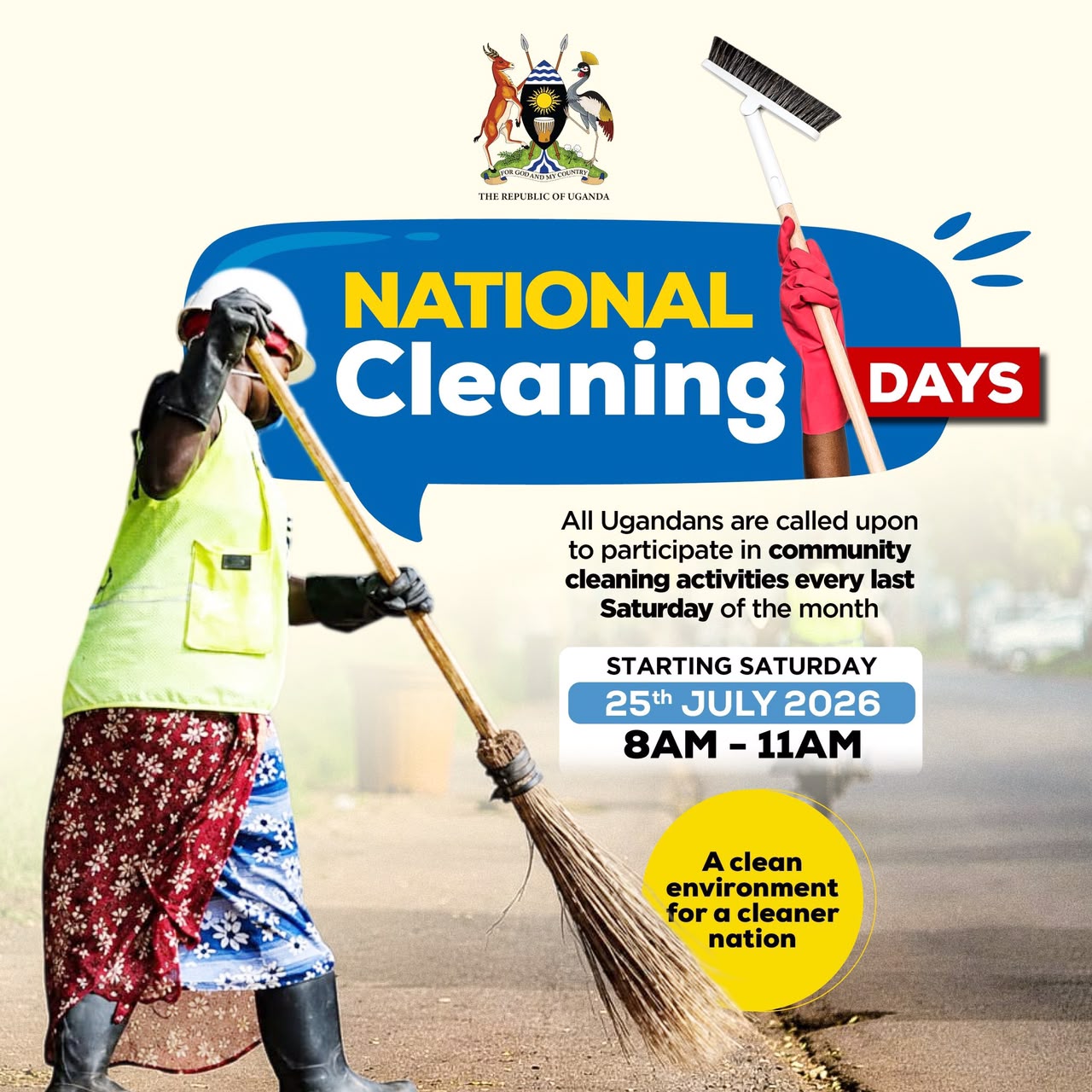
Saturday, 25 July 2026. 7:00am.
The roads are empty. The bodas are parked. The taxis are off. The markets are quiet.
For 3 hours, Uganda is told to stop moving and start sweeping.
Vice President Jessica Alupo will launch the first National Cleaning Day in Kiti Zone, Kisenyi, Kampala. The Prime Minister, Ministers, Permanent Secretaries, and local leaders will be there with brooms.
After that, every last Saturday of the month, from 7am to 10am, the same directive applies nationwide. No vehicles. No motorcycles. No bicycles. No vessels. Only emergencies.
The goal, as stated: a cleaner environment, better public health, and prevention of diseases linked to poor sanitation.
On paper, it sounds simple. On the ground in Uganda, nothing that stops a boda is ever simple.
The Case For It: Why This Matters
Walk through Kisenyi, Owino, Nakasero, or any trading centre after rain and you know the problem.
Drainages blocked with kaveera. Garbage piled next to food stalls. Mosquitoes breeding in stagnant water. Cholera and typhoid don’t ask for your political party.
We have laws on sanitation. We have bylaws. We have KCCA workers. But the city still dirties faster than we clean it.
The government’s logic is clear: if everyone cleans for 3 hours, once a month, together, the load becomes lighter. It’s the _“bulungi bwansi”_ model updated for 2026.
And the symbolism matters. When the Vice President and Prime Minister are in gumboots, it sends a message: this is not just for “the people.” This is for all of us.
The Problem: You Cannot Enforce Culture
Here is where ordinary Uganda has questions.
“How do we survive those 3 hours?”
For the mama selling Rolex in Kisenyi, 7-10am is prime time. For the boda man, it’s market supply. For the hardware shop, it’s when contractors buy cement. Tell them to close for 3 hours every month and you are telling them to lose income.
“Who cleans what?”
If I sweep in front of my shop, who cleans the drainage 200 meters away? Who collects the garbage after we pile it? KCCA trucks must be ready, or we will just be moving rubbish from one corner to another.
“Will it be enforced fairly?”
The directive says “except emergencies.” But Ugandans remember past lockdowns. The fear is that it becomes: _no boda for you, but convoy for them._ Trust is earned in how the first Saturday is handled.
And the sarcasm online says it all: _“We thank the government for informing us a month in advance.”_ That was meant as a joke. It shows how little notice people feel they get for things that affect their livelihood.
The Elite Uganda View: Policy Without Systems Fails
For planners, NGOs, and business owners, the question is not about the broom. It’s about the system behind the broom.
Waste Management: Cleaning without collection is theatre. Where are the trucks? Who pays for disposal? Every Saturday we need KCCA, NEMA, and private garbage companies on standby.
Data: How will we measure success? Less cholera cases in 6 months? Cleaner drainage in Kisenyi? Without data, this becomes a photo op.
Incentives: Fining people is easy. Rewarding them is better. Tax breaks for businesses that maintain clean premises. Recognition for the cleanest parish.
*Consistency: One big launch with cameras is easy. The 6th Saturday, when no minister shows up, that’s the real test.
A clean country is not built in 3 hours. It’s built in the other 165 hours of the week when no one is watching.
What Would Make This Work
If we are serious, then 7-10am cannot just be about sweeping. It must be about 3 things:
1. Ownership, not orders
Don’t just tell people to stay in their areas. Give LC1s tools, gloves, and a budget. Let communities decide: “This month we unclog this drainage. Next month we paint this market.”
2. Services must move too
Hospitals, pharmacies, and cross-border trucks are exempted. Good. But also plan for garbage trucks, water bowsers, and market vendors to have designated times to operate after 10am.
3. Education, not just enforcement
Use those 3 hours for health talks. Why don’t we throw plastic in drains? How does a clean toilet save a child’s life? The Vice President in Kisenyi should talk, not just sweep.
Conclusion: A Clean Uganda Needs More Than Empty Roads
Empty roads for 3 hours will make good photos.
A clean Uganda will need something harder: habits.
The government has given us the time and the place. Kiti Zone is the start. The rest is on us.
Will the boda man use the time to clean his stage instead of sleeping?
Will the shop owner sweep and also stop throwing kaveera in the gutter?
Will KCCA collect what we gather?
Will ministers come back on month 3, 4, and 5?
If the answer to all of those is yes, then 3 hours a month can work.
If the answer is no, then we will have clean roads for 3 hours, and a dirty country for the other 717.
Good health does start with a shared mindset.
But mindset without garbage trucks, without water, without consequences for littering, is just wishful thinking in a reflector jacket.
Let’s show up on Saturday. With brooms. And with the expectation that after 10am, Uganda will actually look different.