
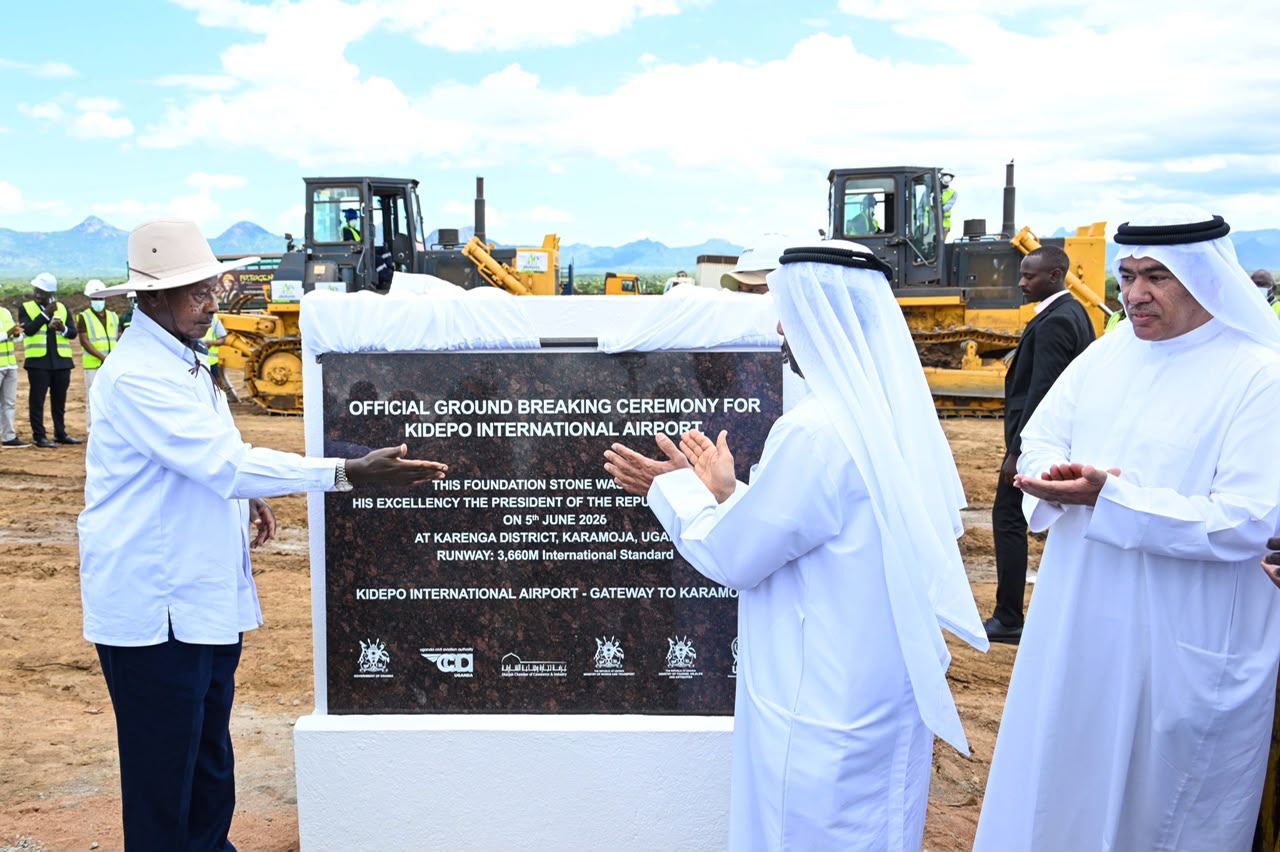
Karenga District felt different today. Dust, speeches, and the sound of machines where once there were only stories of cattle rustling and patrols. Today Afternoon the groundbreaking for Kidepo International Airport was done, and with it Uganda made a direct statement: Karamoja’s chapter of isolation is being rewritten with concrete and steel.
President Yoweri Museveni stood before wananchi and reminded them how far this region has traveled. The Karamoja people know that story better than anyone. Years of insecurity, cattle raids, and lawlessness kept investors away and kept children from dreaming beyond the kraal. Peace changed that equation. When guns go quiet, roads get built. When roads get built, markets open. And now, when runways get poured, the world can land.
More than just an airstrip
This is not a small bush airstrip. The airport is planned with a 3,600-metre runway, wide enough and strong enough to take a Boeing 777. To understand what that means, think in terms of roads. A runway that long, 60 metres wide with shoulders, equals about 30km of two-lane highway. That’s the kind of infrastructure that doesn’t just serve a town – it reorganizes an entire region.
For Kidepo Valley National Park, it’s a game changer. Right now, getting to Kidepo means a long, punishing road journey. Many tourists skip it because time is short and roads are rough. A direct flight changes the math. Fly in, land, see lions before sunset. That convenience turns Kidepo from “Uganda’s hidden gem” into Uganda’s accessible gem. Tourism money doesn’t trickle then – it flows.
But tourism is only one lane of this runway.
Jobs today, markets tomorrow
The president noted that more than 1,600 Ugandans are already employed on the project. That’s 1,600 families with income today, while the concrete is still wet. For young people in Karamoja who have watched opportunities pass them by, this is immediate impact. Construction jobs lead to skills. Skills lead to contracts. Contracts lead to businesses.
Longer term, the airport is a logistics hub. Local products from Karamoja – honey, livestock, crafts, minerals – have always struggled with distance. Markets are far, transport is expensive, and perishables spoil on the road. An international airport collapses that distance. A farmer in Karenga can now think about a buyer in Dubai the same way a farmer in Wakiso thinks about Nakasero Market. That’s the real expansion Museveni was talking about.
Partnership and perception
Sharjah Chamber of Commerce from the UAE is the partner here. An MOU was signed back on 21st June 2024 with then Minister of Works and Transport Gen. Katumba Wamala, witnessed by the president. Today the ground was broken. The UAE’s involvement matters because it signals confidence. Investors don’t pour money into places they think will fail. When Sharjah puts money on Karamoja, other investors start doing their own calculations.
But partnerships also bring scrutiny. Ugandans will watch to see how the deal is structured, who gets the contracts, and whether the jobs and benefits stay local. Infrastructure is only transformative if the people it’s built for actually use it and own it. Karamoja has heard big promises before. This runway has to deliver more than planes. It has to deliver trust.
Critical question: will Karamoja be ready?
The biggest risk isn’t engineering. A 3.6km runway can be built. The harder part is what happens after the planes land.
Local capacity: Will Karamoja’s youth be trained as pilots, technicians, hotel managers, and tour guides? Or will all the skilled jobs be imported? An airport without local skills becomes a transit point, not a transformation point.
Land and community: Big infrastructure changes land value overnight. Who benefits from that? The community must be part of planning so that displacement doesn’t replace development.
Maintenance: Uganda has built facilities before that looked world-class on day one and struggled on year five. Karamoja’s dust, heat, and remoteness will test maintenance budgets. A runway that cracks helps no one.
Security: Peace made this possible. If insecurity returns, tourists won’t come and investors will freeze. The airport’s success depends on keeping Karamoja stable, not just building it.
The symbolism is heavy
There’s something poetic about replacing rustling with runways. For decades, Karamoja’s identity in national conversation was “problem region.” Today it’s “investment destination.” That shift matters psychologically. When young people in Kotido or Kaabong see planes landing instead of patrol trucks, ambition changes. Infrastructure tells people their place matters.
Museveni called strategic infrastructure a catalyst for economic transformation. He’s right, but catalysts only work if other ingredients are present. Electricity, water, trained workers, honest procurement, local leadership. The airport is the headline. The follow-through will be the story.
Bottom line
Kidepo International Airport is a bold bet. 3,600 metres of concrete aimed at ending Karamoja’s geographic penalty. If done right, it brings tourists to Kidepo Valley, opens markets for local goods, creates real jobs, and changes how Uganda and the world see Karamoja.
The groundbreaking happened today. The real work starts tomorrow. Karamoja has come a long way from lawlessness. Now it has to prove it can go even further – from groundbreaking to breakthrough.