
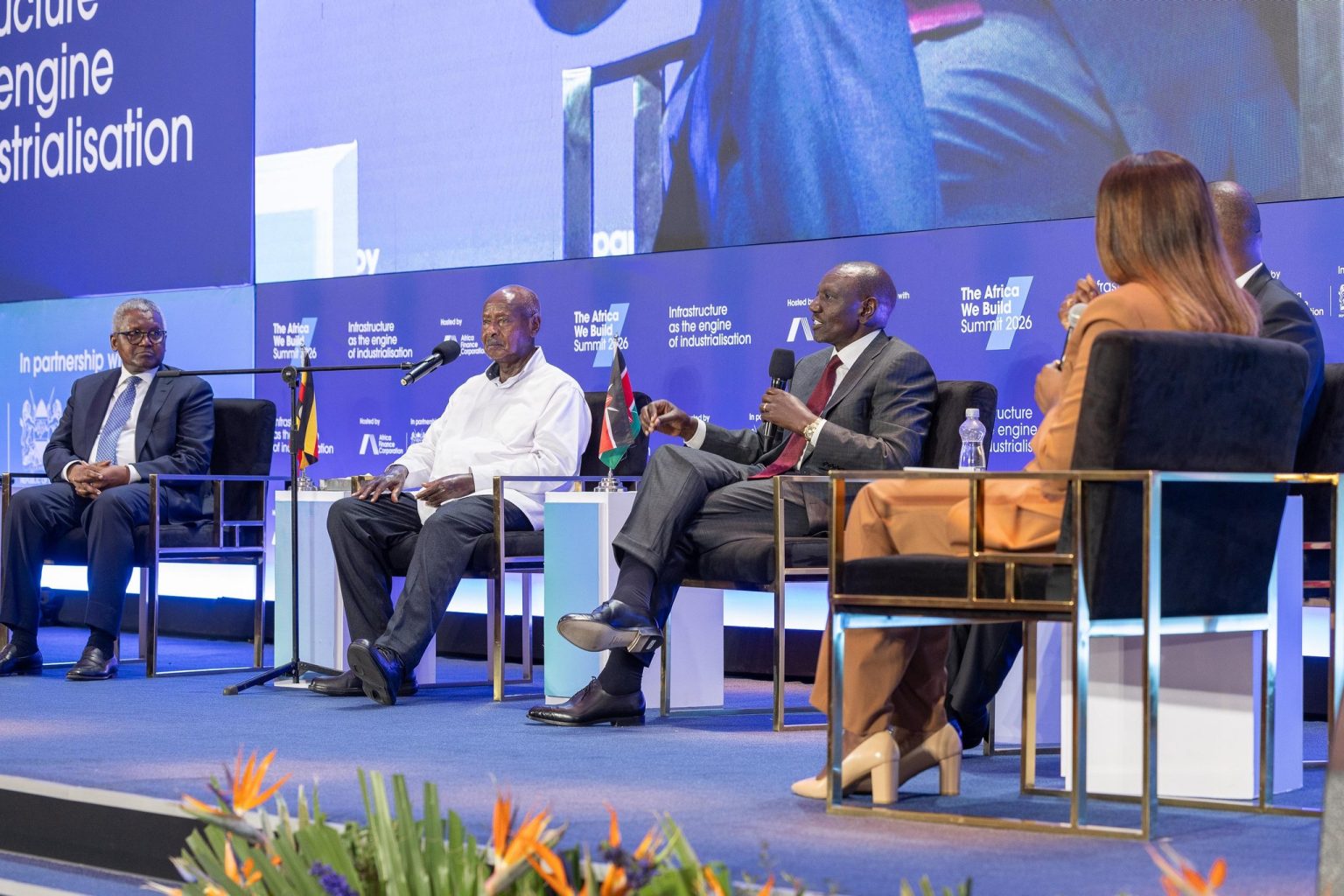
The line that will haunt Uganda’s Ministry of Energy came from William Ruto.
He told the crowd in Nairobi that President Museveni warned him: “If some people were given the chance, they would sell the oil at a throwaway price and go buy perfume.”
The room laughed. Then it went quiet. Because everybody knew who “some people” were.
That was the mood at The Africa We Build Summit 2026. No diplomacy. No “we continue to engage stakeholders.” Just three men — Yoweri Museveni, William Ruto, and Aliko Dangote — standing on one stage and calling Africa’s business model what it is: stupid.
The Bill We Pay for Being Raw
Dangote started it. “I congratulate President Museveni for his bold decision to ban the export of raw minerals,” he said. Then he dropped the commitment everyone was waiting for: “I also want to commit to the two presidents present here that, with their support for the refinery, we will build one in East Africa similar to the one we have in Nigeria.”
Stop and do the math. Uganda has 6.5 billion barrels of oil. At $70 a barrel, that’s $455 billion underground. If we ship it crude through Tanga, we get maybe $40 a barrel after pipeline fees, transport, and “market discounts”. Refine it, and the same barrel gives you petrol, diesel, jet fuel, plastics, fertilizer.
We are leaving $80 on the table. Per barrel. Times 6.5 billion. That is $520 billion over 25 years.
That is why Ruto said “perfume”. Because we’ve been selling the cow to buy milk.
Gold is worse. We dig it in Busia, fly it to Dubai at $1,800 an ounce, and buy back wedding rings at $2,500. The $700 didn’t disappear. It paid a salary in Dubai.
Iron ore? Same story. We have it in Kabale and Muko. We ship it to China. China sends us roofing sheets. We call it development.
Museveni banned raw mineral exports in 2023. Miners rioted. Smugglers got rich. But in Nairobi, that ban got him a standing ovation and a refinery pledge.
Why a Dangote Refinery Changes Everything
Look at Nigeria. For 50 years, Africa’s biggest oil producer imported petrol. Fuel queues were normal. Subsidies killed the budget. In 2023, Dangote’s 650,000 barrel-per-day refinery started.
Today Nigeria exports petrol to Europe. The refinery employs 30,000 people. It supports 150,000 indirect jobs — truck drivers, welders, food vendors, engineers. It killed the subsidy regime overnight.
That is the “Nigeria-style” plant he promised East Africa.
Uganda’s oil fields in Tilenga and Kingfisher will produce 230,000 barrels per day from 2027. Without a refinery, every drop goes into the EACOP pipeline to Tanzania. We become a tenant on our own oil. With a refinery, we become the landlord.
And Ruto knows it. “President Museveni, I want to assure you that the same way you invested in Kenya Pipeline, Kenya is going to invest in your refinery,” he said.
Translation: Kenya will put money in. Because Kenya spends $4 billion a year importing fuel. If that fuel comes from Hoima instead of Saudi Arabia, Kenya saves dollars, cuts pump prices, and keeps the politics calm.
This is not Pan-Africanism. This is petrol economics.
The Hard Part: ‘With Their Support’
Dangote didn’t say “I will build”. He said “with their support”.
That line has buried bigger projects.
Support means land. A refinery needs 2,000 acres. Hoima land is now Shs100 million per acre because speculators heard “refinery” in 2020. If government waits for market price, Dangote walks.
Support means taxes. Nigeria gave Dangote a 10-year tax holiday, free land, and duty-free import of equipment. Parliament in Kampala will call that “selling the country”. But Nigeria now earns $20 billion a year in taxes from the refinery’s value chain. You have to lose small to win big.
Support means no perfume buyers. Those are Ruto’s words. The middlemen. The ministers who delay a signature until their cousin gets a supply contract. The committee that wants a “benchmarking trip” to Dubai before approving a lay-out plan. Dangote doesn’t do bribes. He does exits.
If Uganda and Kenya give him speed, he gives them a refinery. If they give him bureaucracy, he gives them a press statement and builds in Angola.
What Museveni Refused
Ruto’s praise was specific: “He could have allowed Uganda’s oil to go the way others wanted, but he stood firm.”
“Others” means TotalEnergies. Means CNOOC. Means the early pipeline deals that had Uganda selling crude at the wellhead and forgetting about it.
Museveni insisted on a refinery clause in 2018. Oil companies said it was “not commercially viable”. They wanted all 230,000 barrels per day in a pipe. He refused. The project delayed five years. He got called stubborn.
In Nairobi, stubborn became strategy. Because the man with the money — Dangote — just said the refinery is viable if two presidents back it.
The same oil companies that said “no” will now be asked to supply crude to Dangote’s plant. Museveni waited them out.
The Jobs Africa Ships Away
Here is the human cost of raw exports.
One tonne of iron ore shipped to China = 1 job for a Ugandan loader.
One tonne of iron ore made into steel in Jinja = 14 jobs: furnace, rolling, welding, transport, sales.
One barrel of crude shipped to India = $2 in tax for Uganda.
One barrel refined in Hoima = $18 in tax, plus jobs for a chemist, a plant operator, a safety officer, a driver.
We have been exporting jobs for 60 years and calling it “foreign exchange”. Nairobi was the first time three leaders said it out loud.
What Happens Next
Location fight. Hoima wants it. Kabale wants it. Kenya will want it in Eldoret if Uganda delays. The one who gives land fastest wins.
Financing fight. The refinery is $10 billion. Dangote will fund 40%. The rest is Uganda, Kenya, and banks. If Finance Ministry says “no money”, the deal dies.
Timeline fight. Nigeria’s took 7 years. If East Africa takes 12, Dangote will be 78 and retired.
The Africa We Build Summit was the easy part. Microphones are cheap.
The Choice: Perfume or Petrol
Ruto’s line wasn’t a joke. It was a policy document.
Every government has people who prefer quick cash. Sell the ore. Get the commission. Buy the perfume. Retire in Dubai.
Museveni’s ban said no. Dangote’s pledge said there’s another way.
If Uganda and Kenya support it, the next 25 years look like this: fuel cheaper than Kenya, fertilizer cheaper than Brazil, 50,000 jobs, and plastics made in Namanve instead of Guangzhou.
If they don’t, we’ll be in Nairobi in 2030, at another summit, still explaining why Africa is rich but Africans are not.
The perfume is on the shelf. The petrol is underground.
Nairobi just asked us to choose.