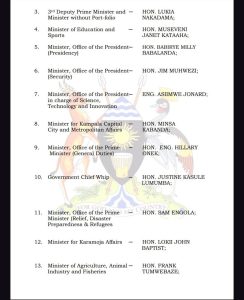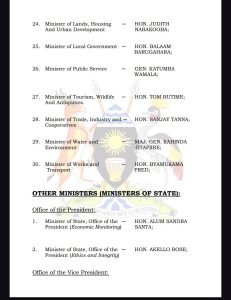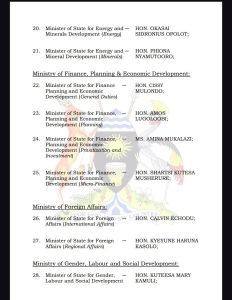

The proposed cabinet for 2026-2031 is out. It’s not a clean sweep. It’s a calibration.
President Museveni has kept the top line steady: Jessica Alupo stays as Vice President, Robinah Nabbanja as Prime Minister. Rebecca Kadaga returns as 1st Deputy PM and EAC Minister. The old guard remains in place across Finance, Defence, Internal Affairs, and Foreign Affairs.
But look closer and three names stand out as the real movers in this list: Justine Nameere, Balaam Barugahara, and Sam Mayanja. They’ve been handed dockets that matter and visibility that matters more.
The Big Eaters: Who Gained Ground
Justine Nameere – Minister of State for Local Government
Local Government is where policy meets the parish. It controls PDM rollout, parish chiefs, and the interface between Kampala and district administrations. Putting Nameere here signals two things: a push to tighten delivery at district level, and a bet on a younger, urban-linked politician to manage a ministry that’s often been a dumping ground for recycled cadres. If she can get parish chiefs working and SACCOs accountable, she becomes a national name fast.
Balaam Barugahara – Minister of Local Government
Balaam moves from the periphery of state media and youth mobilization into a full cabinet docket. Tourism, Wildlife and Antiquities is a revenue earner and a diplomatic portfolio. It’s also a space where personality and international networking matter. For a government that needs to show it’s engaging youth and the entertainment class without losing control, Balaam is the bridge. Expect more celebrity diplomacy, more events, and more pressure to convert “Tourism” into actual forex and jobs.
Sam Mayanja – Attorney General
This is the legal heavyweight appointment. Mayanja steps into the AG’s office with a reputation for land and property disputes. With land conflicts still the number one source of local violence and investment friction, this pick tells you where the fire is. His docket will define how the state handles land titling, evictions, and investor protections. For the elite, this is the person to watch. For the ordinary Ugandan, he’s the person who could unblock or complicate your land case.
What Stayed the Same, and Why That Matters
Janet Museveni stays in Education and Sports. Frank Tumwebaze keeps Agriculture. Henry Musasizi remains in Finance. Kiryowa Kiwanuka holds Defence.
That continuity tells you the economic and security core isn’t up for experimentation. Finance and Agriculture are central to the Parish Development Model and import substitution agenda. Defence and Internal Affairs are about stability heading into a new term. Changing them now would signal uncertainty. Museveni isn’t signaling uncertainty.
The same applies to Janet Kataaha Museveni in Education. Despite persistent criticism of the sector, the signal is clear: this is family, and this is non-negotiable. For parents and teachers, expect no radical overhaul. For the elite, expect the same procurement and policy channels to remain.
The Structural Tweaks You Shouldn’t Miss
Three shifts in structure tell you where the next 5 years are headed:
Science, Technology and Innovation gets a dedicated docket. Eng. Asiimwe Jonard takes it under the Presidency. That’s a signal that the state wants direct control over the tech and innovation agenda, separate from ICT and Education. If it’s funded and insulated from turf wars, this could be where startups and research get real state backing.
Energy and Minerals stays with Monica Musenero. The oil, minerals, and power deals are now hers to run. With oil production timelines approaching, this docket is more about negotiation and delivery than policy papers. The money and politics around Tilenga, Kingfisher, and EACOP will run through here.
More ministers of state for regional affairs. Bunyoro, Teso, Luwero-Rwenzori, Karamoja, Northern Uganda all have their own junior ministers. This is classic political management: give each region a face at the table. It won’t fix service delivery alone, but it reduces the excuse that “we weren’t represented.”
What’s Missing From the List
There’s no major shakeup in Health, Education, or Water. Those are the three sectors where Ugandans feel service delivery most directly. If Jane Ruth Aceng, Chris Baryomunsi, and Beatrice Anywar stay in place, the scorecard for 2031 will look a lot like 2026.
Also missing: a clear succession signal. No one in this list has been positioned as heir apparent. Kadaga is back, but at 1st DPM. Nabbanja remains PM, but without a bigger portfolio. The generational transition is still deferred.
For the Ordinary Ugandan
Your day-to-day won’t change because of names. It’ll change if Nameere gets parish chiefs to actually show up, if Tumwebaze makes seed and extension services work, and if Aceng fixes drug stockouts.
Watch the State Ministers for Local Government, Agriculture, and Health. That’s where the money and the problems meet on the ground.
For the Elite and Investors
The dockets to watch are Attorney General, Energy & Minerals, Tourism, and Science & Innovation. Land disputes will be adjudicated faster or slower depending on Mayanja. Oil and mineral deals will be negotiated by Musenero. Tourism branding and partnerships will be run by Balaam. And if STI gets funded, it’s where the next wave of state-backed tech deals will come from.
Bottom Line
This cabinet isn’t a revolution. It’s a reinforcement with three new faces pushed forward. Nameere gets the delivery docket. Balaam gets the visibility docket. Mayanja gets the legal docket that decides who owns what.
The next 5 years will be judged on whether those three can turn visibility and legal power into roads, clinics, and land security that reach the parish level.
If they do, this list will look smart. If they don’t, it’ll look like more of the same.
Full List Below :